
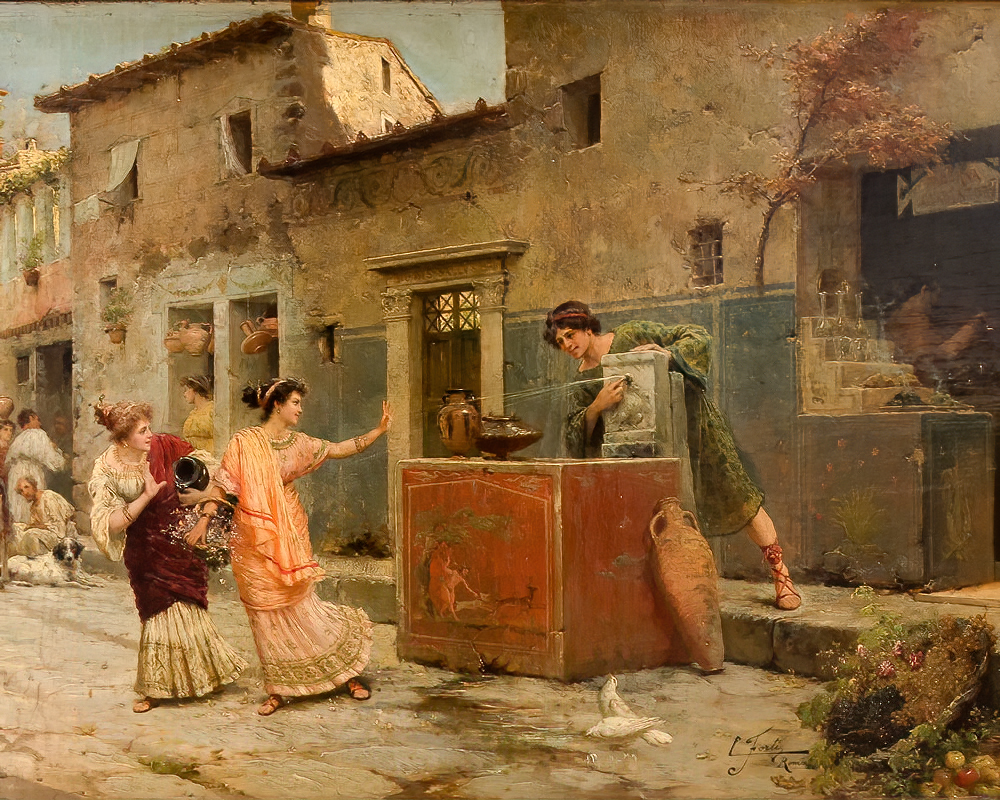
Take a stroll through an ancient Roman city on your day off. Part One.
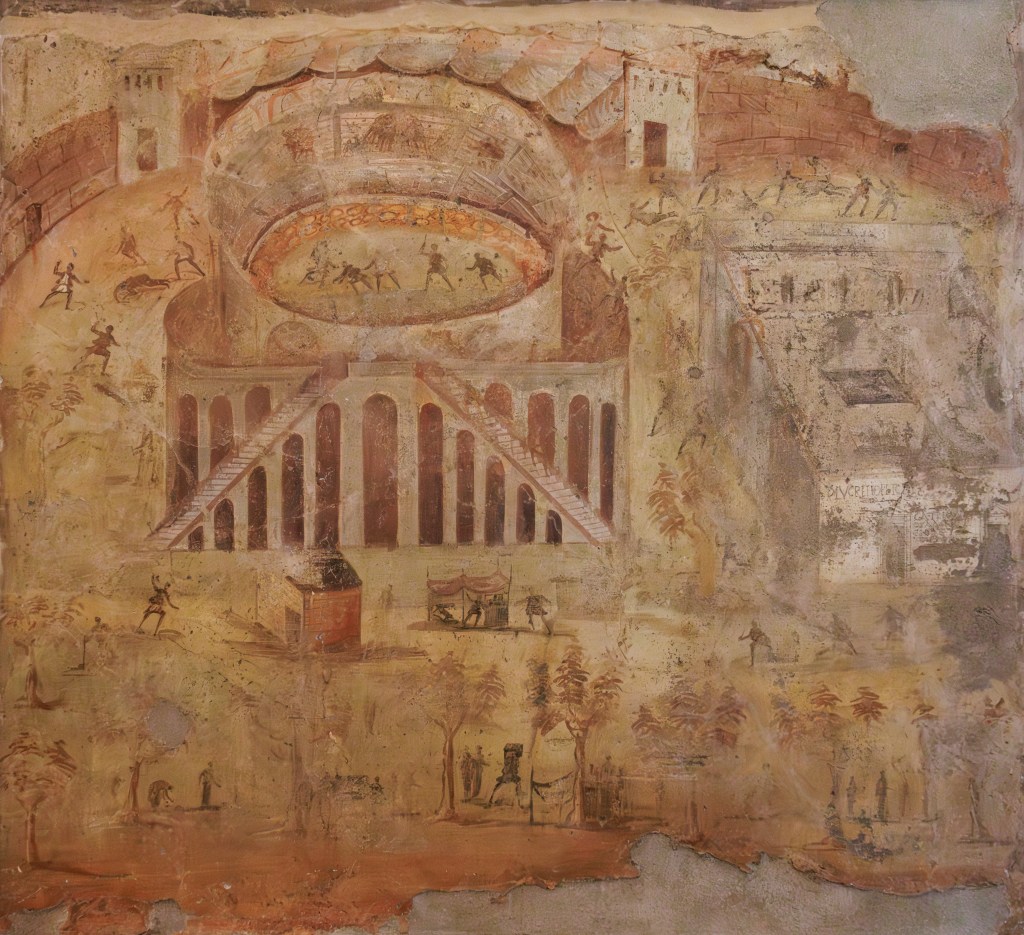
https://commons.wikimedia.org/wiki/File:Fresco_depicting_the_riot_between_Pompeiians_and_Nucerians_in_the_Pompeii_amphitheater_in_59_CE.jpg
Level 1 Beginner
Vocabulary
- Bucket (noun) – A round container with a handle, used to carry water or rubbish.
- Fresh (adjective) – New and not old; food that was made or picked a short time ago.
- Neighbours (noun, plural) – The people who live near you.
- Shrine (noun) – A small, holy place where people pray or leave gifts for a god.
- Slave (noun) – A person who is owned by another person. A slave has to work and is not free. (Note: The proper term today is ‘Enslaved person’)
- Incense (noun) – Something you burn to make a sweet smell in a religious place.
- Chariot (noun) – An open cart with two wheels, pulled by horses, used in races.
- Amphitheatre (noun) – A big, round, open building where Romans watched games and shows.
- Cheer (verb) – To shout happily to show that you like something.
Text
You wake up early. The sun is up. You live in a city in the Roman Empire. Your home is very small. It has only one room. You live here with your family. Your home is above your shop in a large building. There are many other flats and shops in the building.
Many families live in your building. The homes at the top are cheap and not safe. Sometimes they burn or fall down. Your home has no water and no toilet. You only have a bucket to use as a toilet. You do not stay at home much. You spend most of the day outside.
You smile. Today is a games day! You do not have to work today. You are very happy. You clean your teeth with crushed bone and eggshell. This makes your teeth white. White teeth are good in your city.
You get dressed. You go down to your shop. You think about buying a slave. Many people own slaves here. A slave can work in the shop. A slave can carry water and do jobs for you. But a slave is very expensive. Maybe you will have enough money in a few months.
You stop at a small shrine by the door. You ask the gods for good luck. Your cousin is on a boat far away. You ask the gods to keep him safe. You give the gods some wine and a little incense. You promise them bread and cakes if they help you. The gods do not help for free!
You go out for breakfast to your favourite place to eat. You love this place. The bread is fresh. You see your neighbours, Rufus and Felix. They talk about the chariot races. You eat bread, olives, cheese, and figs. You drink wine mixed with water. Nobody here drinks wine without water.
Then you walk to the amphitheatre. It is a very big, round building. It is made of stone. Many people are there, and it is noisy. You go inside and find your seat. Rich men sit at the front. Women sit at the back.
A horn sounds. Everyone is quiet. An important man in the city paid for the games. He wants people to like him. Musicians play. The rich man and his family walk in. You cheer!
Then the priests kill an animal for the gods. Now the games can begin!
This is the end of Part One of A Day in Your Life in the Roman Empire.
Your turn
Here are some easy questions. Try to answer them with a friend or tutor. Try to use the new words.
- Do you think life during this time was good? Why?
- What do you eat and drink for breakfast? Is it like the Romans?
- Would you like to go to the games? Say why or why not.
Did you find this level of English comfortable? Then congratulations! Now you can try the next level of difficulty below.
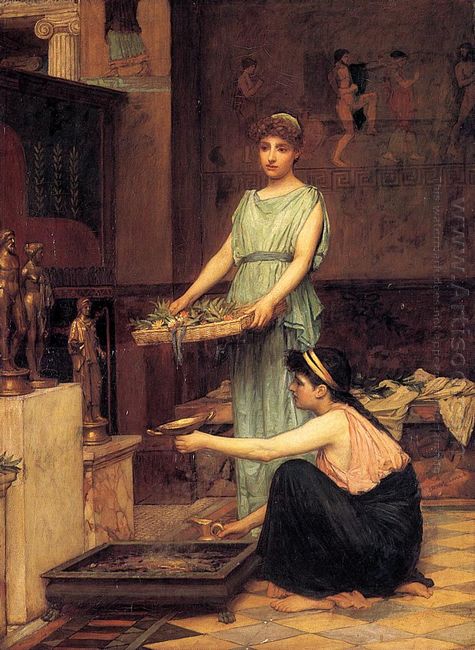
https://commons.wikimedia.org/wiki/File:%22The_Household_Gods%22.jpg
Level 2 Intermediate
Vocabulary
- Tavern (noun) – A place where people go to drink alcohol and sometimes eat, similar to a pub or bar.
- Admire (verb) – To like and respect someone or something very much.
- Tempting (adjective) – Something that makes you really want to do it or have it, even if you know you probably should not.
- Chores (noun, plural) – Small, boring jobs that you have to do regularly, such as cleaning or washing the dishes.
- Shrine (noun) – A small, holy place where people pray or leave gifts for a god or spirit.
- Incense (noun) – A substance that is burned to make a sweet smell, often used in religious ceremonies.
- Procession (noun) – A line of people walking slowly together, usually as part of a ceremony or celebration.
- Magistrate (noun) – An important local official in ancient Rome, often rich and powerful.
- Sacrifice (verb) – (1) To kill an animal as a gift to a god in a religious ceremony. (2) To give something up to achieve some goal
- Barbarian (noun) – An insulting word the Romans used for a person from outside their empire, seen as wild or uncivilised.
Text
You wake up when the sun rises. You are one of many people living in an ordinary city in the Roman Empire. Your home is small – just one room for you and your family. It is above your shop in a large apartment block. Your flat is better than the ones higher up, which are built with cheaper materials. Those flats catch fire or fall down more easily, so the higher you live, the more dangerous it is. Your room has no running water, no kitchen, and no toilet. Well, you have a bucket. For you, this room is just a place to sleep. You spend most of your life outside.
You stretch and smile. You are glad you did not open a tavern or a food shop. Those places will be very busy today, because today is a games day in your city. You feel excited. You can afford to take the day off, and you cannot wait to see the show. You take some crushed bone and eggshell from a bowl and rub your teeth clean. This also makes your teeth white, which people admire in your culture. You feel proud of your bright, clean teeth.
You get dressed and walk downstairs through your shop. You stop and think. You did not want to close the shop today, but the games were too tempting. If you bought a slave, they could run the shop and do your daily chores, like carrying water from the public fountain and emptying that bucket. But your partner says a slave is too expensive right now. Maybe in a few months, if business goes well and the gods are kind.
You stop at the small shrine near the door. You cover your head with a cloth to show respect and raise your hands. You ask for good luck, and you ask the gods to protect your cousin, who is on a dangerous sea journey. You drop a little incense and pour some wine on the shrine. You promise fresh bread and honey cakes if the gods help you. After all, they will not help for free. Then you blow a kiss to the shrine and head out.
Your first stop is your favourite breakfast place. The bread is always fresh, and you love its smell mixed with olives. You stand at the bar and greet your neighbours. Rufus and Felix are arguing about the chariot races again. Rufus supports the Greens, and Felix supports the Blues. You have never been to the capital, but you hope to watch the races there one day. You eat bread with garlic and olive oil, olives, cheese, and figs. You drink wine mixed with water – only a barbarian drinks wine without water!
Full and happy, you hurry to the amphitheatre. The huge oval building comes into view. A large crowd is already there, and you push your way inside.
The seats are separated by class and gender. That means important men sit at the front, ordinary people higher up, and women at the back. The games are free because they are a gift to the people of the city. You excitedly take your seat and wait.
You hear the sound of a horn, and the crowd goes quiet. A man walks onto the sand and thanks the magistrate who paid for the games. Then musicians lead a procession, and the leader of the city, the magistrate, and his family appear. You cheer with everyone else. Rich men pay for games like these to win the people’s support and become more popular. You are not complaining. This is an exciting day.
Finally, the priests sacrifice a bull to the gods. The crowd stays quiet and respectful. Now the games can truly begin.
This is the end of Part One of A Day in Your Life in the Roman Empire.
Your turn
Here are some questions to help you understand the text and remember the new vocabulary. Try answering them with a friend or tutor, or write the answers down. Try to use the new words in your answers.
- The Romans spent most of their lives outside their small homes. How do you think this changed the way they lived together as a community?
- In the text, buying a slave is described as a normal, tempting choice, mostly because it would remove daily chores. Why do you think slavery felt so normal to people at the time?
- At the shrine, the person promises the gods bread and cakes if the gods help them first. Do people still make deals like this today, in religion or in superstitions? Can you think of an example?
- A rich magistrate paid for the whole day of games to become more popular. How do rich or powerful people today use gifts, sport, or entertainment to win people’s support?
Did you find this level of English comfortable? Then congratulations! Now you can try the next level of difficulty below.
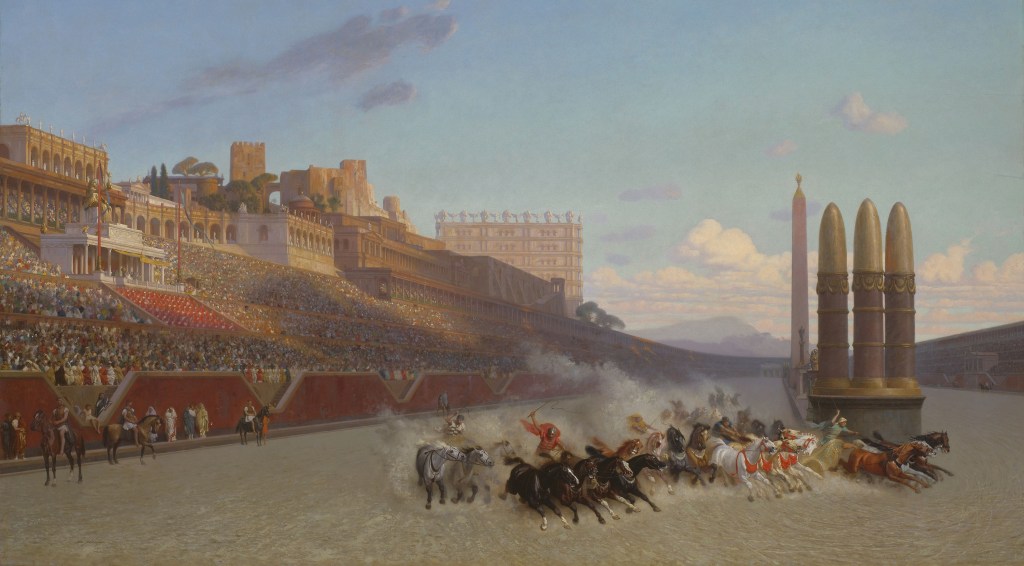
https://commons.wikimedia.org/wiki/File:Jean_L%C3%A9on_G%C3%A9r%C3%B4me_-_Chariot_Race_-_1983.380_-_Art_Institute_of_Chicago.jpg
Level 3 Advanced
Vocabulary
- Neat (adjective) – (When referring to alcohol) served strong and straight, without any water or ice mixed in.
- Amenities (noun, plural) – Useful features or facilities that make a building comfortable to live in, such as running water, heating, or indoor toilets.
- Reluctant (adjective) – Feeling unwilling or hesitant to do something.
- Perilous (adjective) – Full of extreme danger or risk.
- Spectacle (noun) – A visually striking public performance or display that is exciting and impressive to watch.
- Segregated (adjective) – Separated or divided into different groups, usually based on class, gender, or race.
- Niche (noun) – A shallow hollow or small space carved into a wall, typically used to display a statue or shrine.
- Mortals (noun, plural) – Human beings; a word used to contrast living, breathing humans who will eventually die with the immortal gods.
- Goodwill (noun) – A friendly, helpful, or cooperative feeling towards other people; public support and approval.
- Out and about (Idiom) – Active and doing your normal daily activities away from your home.
- To play your cards right (Idiom) – To behave in a smart, careful, and strategic way in order to achieve success or get exactly what you want.
Text
You wake with the coming of dawn’s light, one of the many residents of an average provincial city in the Roman Empire. Your flat is cramped, just a single room for you and your family. It is one of a number in the apartment block, right above your shop on the ground floor, and is of better quality than the flats above. They are constructed of cheaper materials and are more at risk of fire or collapse. The higher up you live, the greater the risk. Still, no amenities, no running water, no kitchen, and no toilet – well, you have a bucket. For you, this is a place to sleep, little more. The majority of your life is spent out and about.
You stretch and smile. You give thanks that you did not decide to open a tavern or eatery; they would be especially busy today, for today is a games day in your city. You feel a thrill of excitement; you can afford not to work today, and the promise of spectacle lifts you out of your bed. You take crushed bone and eggshells from a small bowl and rub your teeth clean. This has the added benefit of whitening them, something to be admired in your culture, and you take a small pride in pearly white teeth.
You dress and head downstairs through your shop. You pause and consider. You were reluctant to close the shop today, but the temptation of going to the games convinced you. If you were to buy a slave, you would be able to leave a lot of the running of the shop to them. Not to mention it would mean a reduction in your daily chores like hauling water from the public fountain, which is free to all, or emptying that bucket. You sigh, your partner says it is too big an investment right now. Perhaps in a few seasons you’ll be able to afford one, if you play your cards right and the gods are generous.
You stop at the small shrine that sits in a niche in the wall by the door. Taking some cloth, you cover your head in respect and raise your hands. You ask for luck today and for protection for your cousin who is currently making a perilous sea journey to secure new products. You scatter a pinch of incense and then a splash of wine on the small shrine, promising fresh bread and honey cakes if the spirits give you what you ask for. After all, gods and spirits cannot be expected to help for free. This transaction finished, you raise your hand to your lips and blow a gentle kiss to the shrine before heading out the door.
The first stop is the eatery nearby, your favourite breakfast spot. The bread here is usually fresh, and you love the smell of baked goods mixed with olives. You stand at the bar and greet your neighbours who are already there. Rufus and Felix are arguing about the results of the latest local chariot races again. Rufus supports the Greens while Felix is a diehard fan of the Blues. You have never been to the capital, but you hope that one day you can visit and watch the chariot races in the vast circus everyone speaks of. You dig into your breakfast of bread rubbed with garlic and olive oil. To the side are olives, strips of cheese, and figs. You wash this down with watered wine; after all, only a barbarian would drink wine neat. Full and satisfied, you head out, leaving your neighbours who are still bickering about the races.
The games will start soon, so you hurry over to the city’s amphitheatre. The impressive oval structure comes into view, pale stone and multiple entrances that swallow the crowd that has already gathered. You can hear the excited voices within, and you squeeze your way through the crowd to get inside.
The seating is segregated by gender and class. The most important men are at the front, ordinary people are higher up, with women furthest back. There is no ticket to buy as the games are a gift to the residents of the city. You take your seat in your appropriate area and eagerly wait for the games to begin. A horn sounds, and the crowd quiets. A man strides onto the sand in the centre and begins to talk. He thanks the local magistrate for sponsoring this day of games and announces the planned events for the day. You feel your excitement growing as he speaks. This is going to be something really special, far above the normality of your daily life.
Musicians lead a procession onto the sand. Pipes and horns, attendants carrying images of the gods and the emperor. The magistrate funding the games and his family are there too, their wealth and power on full display. You cheer loudly with the rest of them. This magistrate has paid for the entire day out of his own pocket. Games like these are how the rich and ambitious win the goodwill of the people and raise their standing in the city. A generous magistrate is a popular one, and a popular one goes far. This seems to be working, as he certainly has your support.
Priests come and stand before an altar. They pour wine and sacrifice an animal; today is a fine bull, another expression of the magistrate’s wealth. The crowd is quieter during this part, showing respect to the gods who could have such great and terrible power over mortals like you.
Now, the ceremony is over, and the games can truly begin.
This is the end of Part One of A Day in Your Life in the Roman Empire.
Your turn
Here are some questions to increase your understanding and help you remember any new vocabulary. Try answering them with a friend or tutor, or write the answers down. Try to use any new vocabulary in your answers.
- How do you think spending almost your entire life outside the home changes community life and how people live together?
- Why do you think slavery was considered such a normal and natural part of daily life?
- Many in the ancient world treated their offerings to the gods as a transaction. How is this different from, or similar to, modern religious practices or superstitions?
- In what ways do modern politicians or billionaires use entertainment and public gifts to increase their influence?
Did you find this level of English too easy? Then congratulations! You can try engaging with native-level content or check out some of my other articles.
About the author
Joe Robert Tuckwell is an English tutor and the creator of English with Ideas.
(Below) Eduardo Ettore Forti, Public domain, via Wikimedia Commons
https://commons.wikimedia.org/wiki/File:Ettore_Forti_Roman_Street_Scene.jpg


