Take a stroll through an ancient Roman city on your day off. Part Two.
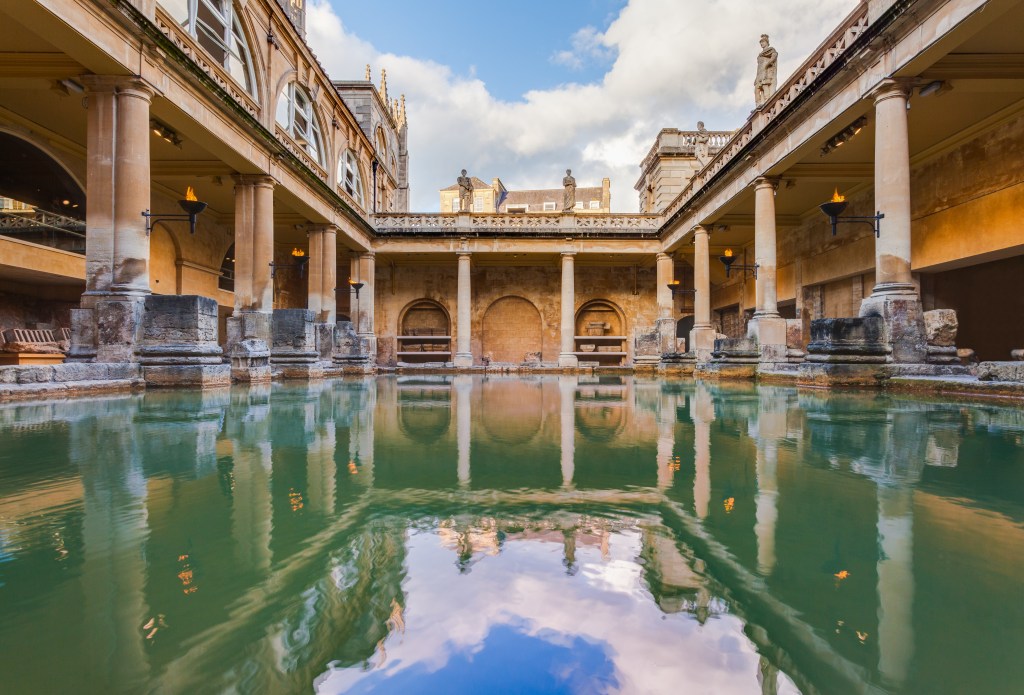
https://commons.wikimedia.org/wiki/File:Ba%C3%B1os_Romanos,_Bath,_Inglaterra,_2014-08-12,_DD_39-41_HDR.JPG
Diego Delso, delso.photo, License CC BY-SA
Level 1 Beginner
Vocabulary
- Arena (noun) – The open, sandy floor in the middle of the amphitheatre, where the fights happen.
- Hunter (noun) – Someone who finds and kills wild animals.
- Gladiator (noun) – A person in Rome who fights in an arena.
- Weapon (noun) – A thing you use to fight or hurt someone, such as a sword or a knife.
- Bet (verb) – To risk money on the result of a game or a fight, hoping to win more.
- Mercy (noun) – Being kind and not hurting someone when you could.
- Treat (noun) – Something nice that you do not have very often.
- To give up (Phrasal Verb / Idiom) – To stop trying to do something because a situation is too difficult.
Text
You sit in the amphitheatre and the games begin.
First come the animal fights. Many animals run into the arena. You know some of them, like bears. But you have never seen a real lion before! Hunters fight the animals. Some animals fight each other, and the crowd cheers. You can smell the blood and the sand.
At midday, guards bring out some criminals. The criminals are killed. This is a normal part of how the law works here. Some people shout and mock them. You feel hungry, so you buy dates with nuts and cheese and a cup of wine with water.
In the afternoon come the gladiators. Gladiators are trained fighters. Some of them are famous. But they are still very low in society. To Romans, gladiators are brave and strong. They can face death without fear.
The gladiators have different weapons.
The fights begin. Many people bet money. You bet on your favourite fighter, Spiculus. You stand up. You want him to win! The fight is long, and both men are tired. Then Spiculus is cut on the arm. He drops his sword and lifts one finger. This means he gives up.
The referee stops the fight. Now the magistrate must choose: life or death? The crowd wants Spiculus to live. The magistrate says Spiculus can live. You are happy about this.
Now you need a bath. You go to the bathhouse. It is cheap. Men and women have separate rooms. You hear people laughing. Some people get a massage. You put oil on your skin, then remove it with a metal tool. You sit in the warm water and talk with the other people. Here, rich and poor people talk together. Then you jump into the cold water. It feels cold but good.
After the bath, you go to a place to eat and order food. You eat soft lentils and a pork sausage. You do not eat meat often, so this is a treat.
Then you smell smoke outside. Fire! Men run past with axes. They will pull down the buildings near the fire to stop it from growing. The fire is far from your home, so you feel safe. But someone has lost their home tonight.
It is nearly night. At night, the streets are very dark and dangerous. Rich people have slaves with torches, but you walk alone. Luckily, you get home safely.
It was an exciting day. But tomorrow will be normal. You will work, eat, and pray to the gods. You are just one of millions of people in the Roman Empire.
This is the end of Part Two of A Day in Your Life in the Roman Empire.
Your turn
Here are some questions. Try to answer them with a friend or tutor. Try to use the new words.
- What do you think of the gladiator fights?
- What do you think of the food in the story?
- In the bathhouse, rich and poor people talk together. Do you think this is good? Why?
Did you find this level of English comfortable? Then congratulations! Now you can try the next level of difficulty below.
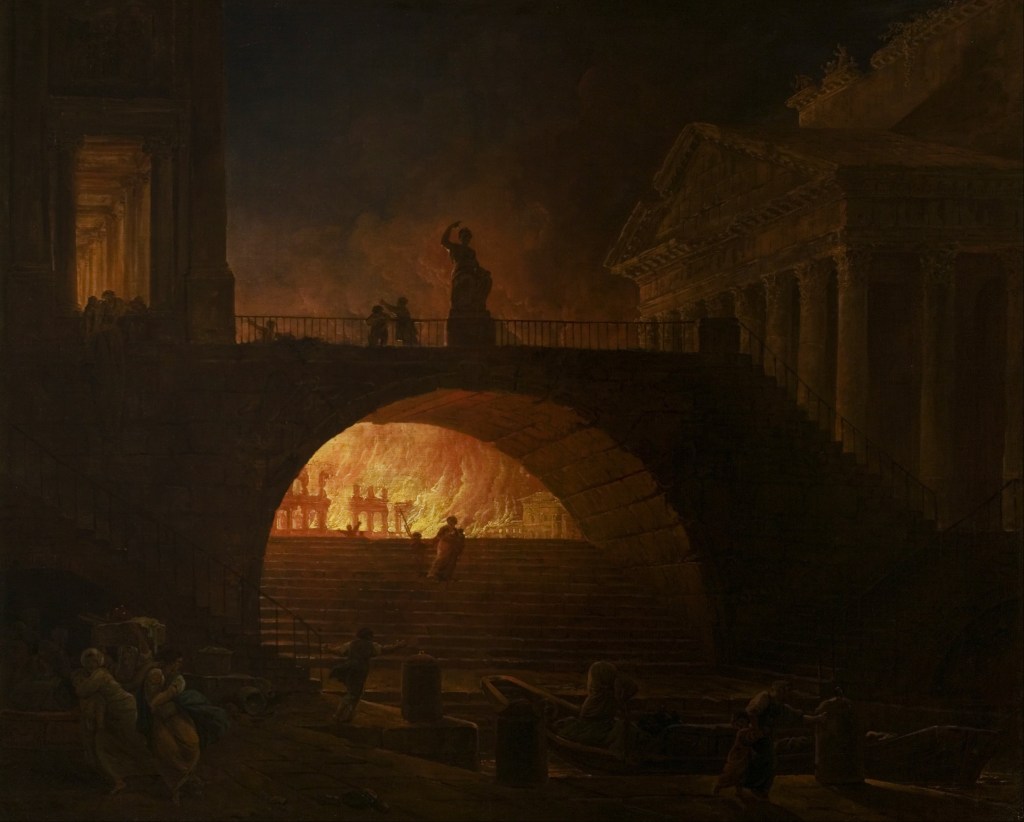
https://commons.wikimedia.org/wiki/File:Hubert_Robert_-_The_Fire_of_Rome_-_Google_Art_Project.jpg
Level 2 Intermediate
Vocabulary
- Mock (verb) – To laugh at someone or say unkind things to show that you do not respect them.
- Courage (noun) – The ability to be brave and face danger, pain, or fear.
- Status (noun) – Your position or rank in society compared with other people.
- Referee (noun) – A person who controls a fight or a game and makes sure the rules are followed.
- Trident (noun) – A long spear with three points, used by some gladiators and linked to the sea god Neptune.
- Echo (verb) – (Of a sound) to be repeated as it bounces off walls or surfaces.
- Glow (noun) – A soft, warm light, such as the light from a fire.
- Treat (noun) – Something special and enjoyable that you do not have very often.
Text
You feel the excitement of the crowd around you. You are sitting in the amphitheatre, waiting for the games to begin.
First come the animal fights. Gates open, and many kinds of animals run into the arena. You know some of them, like bears and boars, but others you have only seen in pictures, like the lion.
Then trained hunters come in with spears and nets. Some animals are made to fight each other, and the crowd cheers at the violence. Even in your seat, you can smell the blood and the sand.
At midday, the mood changes. Guards bring out criminals who have been sentenced to death, and they are killed in the arena. Some people shout and mock them, saying that this is right, and that this is justice. Others just keep chatting. For you, this is a normal part of the legal system. You feel hungry, so you buy dates filled with nuts and cheese and a cup of watered wine.
In the afternoon comes the moment everyone has waited for: the gladiators. These are not criminals. They are trained fighters, and some are as famous as celebrities. But even so, they have very low status in Roman society. To Romans, gladiators show important qualities: courage, toughness, and the strength to face death without fear. Many people also find them very attractive. You have heard that another city has female gladiators, but you have never seen one.
The gladiators all look different and they get into pairs. The fights begin. These are not wild fights with no rules. They are contests of skill. Betting is everywhere, and you have bet on your favourite fighter, Spiculus. You stand up, hoping the small, fast man can beat his strong enemy. The fight is long, and both men are tired. Then Spiculus is cut on the arm. He drops his weapon and raises one finger to show he has given up. It is a sign to ask to stop and to not be killed, to ask for mercy.
The referee holds back the winner and turns to the magistrate, who must decide if Spiculus lives or dies. Most of the crowd wants mercy because he fought well. The magistrate decides: Spiculus will live. You are happy, but maybe you will not bet on him again.
When the games end, the sun is low and your throat is sore from shouting. After all the heat and dust, you need a bath.
You smell your local bathhouse before you see it. Smoke rises from the fires that heat the water. It is cheap, and men and women have separate areas. You pay, change, and go in. Voices and laughter echo off the walls, and some people get massages from slaves. You rub oil on your skin, then scrape off the oil and dirt with a metal tool. You sit in the warm pool and chat. Here, with no clothes, rich and poor people mix freely. Then you jump into the cold pool, and the shock takes your breath away, but you feel fresh.
After dressing, you buy some food: soft lentils with fish sauce and a pork sausage. You do not eat meat often, so this is a treat.
Suddenly, you smell smoke, but not the normal smoke of a cooking fire. A dangerous smoke. Fire! Men run past on the street with axes and hooks. They will pull down the buildings near the fire to stop it spreading. You look out the door and see the orange glow of the fire is far from your home, so you feel relief. But someone has lost everything tonight.
Night is coming, and the streets are very dark and dangerous. There is no street lighting. Rich people have slaves who carry torches, but you walk alone. You hurry home before it gets too dark, and luckily you get home safely.
It has been an exciting day, but tomorrow will be normal again. You will work, eat, bathe, and pray to the gods. You will continue to live as just one of millions of people in the Roman Empire.
This is the end of Part Two of A Day in Your Life in the Roman Empire.
Your turn
Here are some questions to increase your understanding and help you remember any new vocabulary. You can answer them with a friend or tutor, or write the answers down. Try to use any new vocabulary in your answers.
- Romans admired gladiators for their courage, but still gave them very low status. Why do you think this was? Do we treat any celebrities or athletes in a similar way today?
- In the bathhouse, rich and poor people mixed freely. Are there any places today where a person’s status matters less?
- The person in the story lives with constant danger, such as fire and dark, unsafe streets. How might living with this kind of danger change the way a person thinks about life?
- Ordinary people enjoyed watching violence and killing for entertainment. Why do you think this felt normal to them? Do you think people have really changed since then?
Did you find this level of English comfortable? Then congratulations! Now you can try the next level of difficulty below.
Level 3 Advanced
Vocabulary
- Martial (adjective) – Relating to war, fighting, or the military.
- Relish (verb) – To enjoy greatly or look forward to something with extreme pleasure.
- Rampant (adjective) – Spreading out of control; very common, usually referring to something bad or unwanted.
- Churned (adjective) – Violently mixed up or disturbed. In this context, it refers to the sand that has been heavily kicked up and ruined by the fighting.
- Jeer (verb) – To shout rude, insulting, or mocking comments at someone to show disrespect.
- Condemned (adjective) – Officially judged to be guilty of a crime and sentenced to a severe punishment, usually death.
- Grim (adjective) – Very serious, unsmiling, or depressing; showing that someone expects something bad to happen.
- Hierarchy (noun) – A system in which members of a society are ranked in order of their status, wealth, or authority.
- Plea (noun) – An emotional and urgent request for something, such as help or mercy.
- Trident (noun) – A large, three-pronged spear, associated with fishermen and with the sea god Neptune.
Text
You are sitting in the amphitheatre. You feel a shiver of excitement run through the crowd as you as wait for the games to begin.
First come the beast fights. Gates open, and all manner of animals are driven into the arena. Some you recognise, like bears or boars, but others you have only seen in artworks before, like that lion snarling at its captors. You have heard that the great arena in Rome shows exotic beasts from all over the empire, and you wonder about all the strange creatures that inhabit this vast empire and the unknown world beyond.
Now, trained hunters come in to face the beasts with spears and nets. Some of the animals are forced to fight one another instead, and the crowd cheers and chatters excitedly at the display of ferocious violence. The smell of animals, blood, and churned sand reaches you even up here in the seating area.
By midday, the mood changes. Condemned criminals, the lowest of the low, are brought out into the arena and executed – as the law demands and the people crave. Many in the audience jeer and mock the prisoners, calling out that justice needs to be done. Others continue chatting and gossiping; this legal function is just another part of your society like any other.
You are quite hungry at this point and you wave over a vendor walking among the seats selling refreshments. You purchase some dates stuffed with nuts and cheese along with a cup of watered wine to wash away the dust in your throat. The day is starting to heat up now, and the stone under you is warm to the touch.
The afternoon brings with it the moment that everyone has been waiting for. The gladiators. These are not condemned criminals to be thrown away. They are trained fighters – celebrities in some cases – with famous and celebrated careers. Yet, despite the gladiators’ value, they are still extremely low down on the social hierarchy. Your heart beats more quickly as you look at the impressive figures standing on the sand, preparing for battle. They represent the most important Roman virtues: martial courage, toughness, the willingness to face death without flinching, and discipline. Not to mention that to many they are the ultimate symbol of male attractiveness, and objects of desire. And while you have heard rumours of another city hosting a female gladiator show, you have never seen one yourself.
The gladiators on the sand in front of you are split into different groups depending on their equipment. Some are more heavily armoured, others carry different swords, while still others carry a net and trident like a fisherman would use. The fighters are paired off, and the fights begin.
These are not brutal, no-rules brawls, but rather contests of skill and daring. The crowd shout advice at the fighters and discuss as if they themselves were experts. Gambling is rampant, and you have placed a bet on your favourite fighter, Spiculus. You get to your feet as his fight starts, hoping the smaller, faster man can overcome his powerful opponent. The fight lasts longer than the others, and you can see both men are exhausted. You groan along with many others as Spiculus takes a cut to the arm and backs away. He drops his weapon and raises his index finger towards the referee: a sign of surrender and a plea for mercy.
The referee steps in, using his wooden staff to hold back the victor. He turns to the magistrate who will now decide if Spiculus will live or die. Most in the crowd call for mercy; he has fought well after all. The magistrate makes his announcement: Spiculus will live to fight another day. You are happy about this, though you might not be so eager to bet on him in the future.
By the time the last fight ends, the sun has sunk low in the sky and your throat is raw from shouting. You exit with the crowd, down the stairways and through the arches, back onto the streets. After the heat and dust of the arena, you are in desperate need of a bath.
You smell your local bathhouse before you see it. Wood smoke curls up from the furnaces that heat the water day and night, keeping the temperature comfortably warm. You relish the thought of a nice long soak as you approach. This establishment is privately owned, but very cheap. Luckily, it has separate men’s and women’s bathing areas rather than segregated times like many places do, so you don’t need to worry about the time you go to bathe.
You pay your entrance fee and go to change. You leave your clothes neatly folded and enter the main room. Voices and laughter echo off the stone walls, along with the sound of splashing water. To one side, bath patrons are receiving massages from enslaved attendants. The air is warm, damp, and heavy with the smell of olive oil and perfumed creams.
The warm stone beneath your feet already starts to relax you, and you are sweating. Taking some olive oil, you rub it into your skin and then scrape the oil, dirt, and sweat off your body with a metal tool. When you are finished, you head to the warm pools of water and soak a while, chatting with others there. Here, stripped of your clothes, the different levels of society mix and talk far more freely than at any other time. Once you are ready to leave, you plunge into the cold pool. The shock of it steals your breath away for a moment, but leaves you refreshed.
After dressing, you step back out into the late afternoon. It is time to get some food before heading home to rest. You stop at a different eatery from this morning and buy a bowl of lentils cooked soft, mixed with some fish sauce, and a pork sausage. You do not get to eat meat so often, and you enjoy this small treat.
You pause, the food halfway to your mouth, and sniff. You smell smoke, and not the normal wood smoke of the baths or cooking fires, but something sharper, more dangerous. That can mean only one thing: fire! A moment later you hear shouting, and a group of men run past and down the street. Their faces are grim, and they are carrying axes and hooks.
These watchmen are running towards the source of the smoke, likely an apartment block that has caught fire. When they get there, they are going to tear down the buildings around the fire rather than try to put it out. The most important thing is to stop the fire from spreading and consuming the whole city.
You lean out of the eatery door with others and feel a sense of guilty relief. The orange glow of fire is coming from a different part of the city, away from your shop and home. The fear eases but doesn’t fully disappear. Either way, someone has lost everything tonight, and there is no guarantee of safety in a city where a single knocked-over oil lamp could burn a whole district.
The sun has nearly set now, and it is time to hurry home. There is no public lighting on any street corner, and nights here are very, very dark. And dark streets are full of danger. The rich have slaves to walk ahead of them with torches and to protect them. But you have only your own two feet, and someone walking alone as you are is a prime target for thieves or worse.
Thankfully, you make it home before darkness truly falls and enter through your shop front. It has been an exciting day, far more so than usual, but tomorrow will be a day like any other: you will work, socialise, eat and bathe, and make offerings to both gods and spirits for their continued blessings and protection against tragedy. You will continue to live as one of the many millions of souls who exist in the empire of Rome.
This is the end of Part Two of A Day in Your Life in the Roman Empire.
Your turn
Here are some questions to increase your understanding and help you remember any new vocabulary. You can answer them with a friend or tutor, or write the answers down. Try to use any new vocabulary in your answers.
- Why do you think Roman society admired gladiators for their courage and discipline, yet kept them at the bottom of the social hierarchy? Do we have any similar contradictions with celebrities or athletes today?
- Are there any places in our modern society where wealth and status matter less, such as in the Roman bathhouse, or are we always separated by class?
- The article describes a city where sudden disasters, like a fire or violence on the dark streets, are an everyday threat. How might living with this constant danger change a person’s outlook on life compared to how we live today?
- The ordinary citizens enjoyed watching violence and executions as a form of public entertainment and justice. Why do you think extreme violence was such a normal part of their culture, and has human nature really changed since then?
Did you find this level of English too easy? Then congratulations! You can try engaging with native-level content or check out some of my other articles.
About the author
Joe Robert Tuckwell is an English tutor and the creator of English with Ideas.
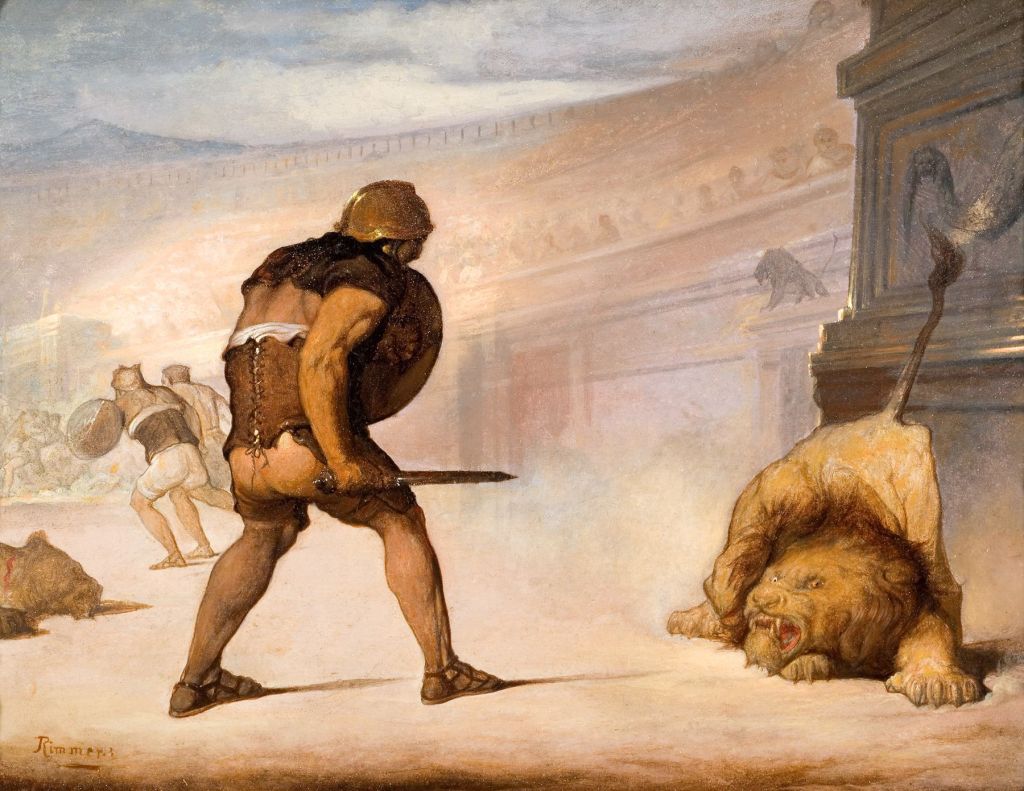
(Below) William Rimmer, Public domain, via Wikimedia Commons
https://commons.wikimedia.org/wiki/File:Lion_in_the_Arena_by_William_Rimmer,_c_1873-76.jpg