
One of the most famous stories once again captures public imagination.
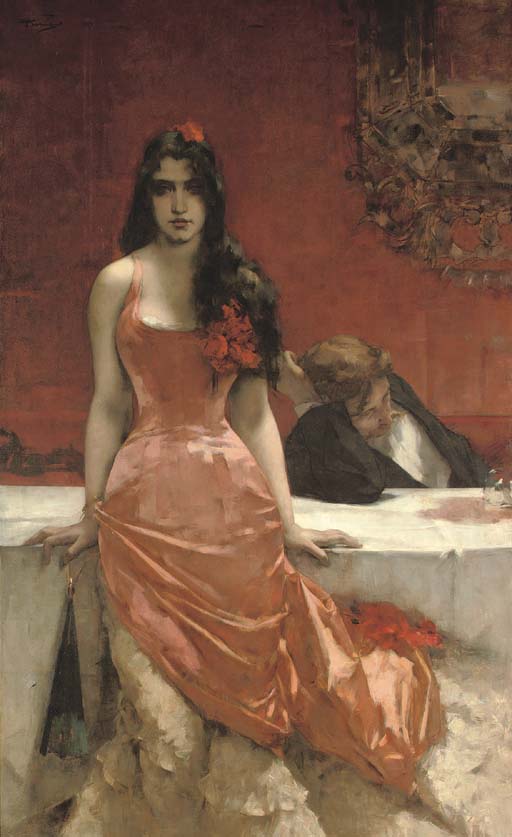
https://commons.wikimedia.org/wiki/File:Charles_Hermans_-_Circe_the_temptress.jpg
Level 1: Beginner
Vocabulary
- To rule (verb): To control a country or a group of people. Example: In the past, many countries were ruled by kings.
- Disappointed (adjective): Sad because something was not as good as you hoped.
- Mystery (noun): Something that people do not understand or know about.
- Escape (verb): To get away from a bad place or situation.
- To play (a character) (verb): To be a character in a film or play. Example: Matt Damon plays Odysseus.
- Realistic (adjective): Like real life.
- Fantasy (noun/adjective): A story with things that are not real, like magic, gods or monsters.
Text
The Odyssey is a very old poem. It is a story about a man trying to get home, gods and monsters, a woman in a world ruled by men, and a son looking for his father.
Christopher Nolan has made a film of this old story. Many people liked it, but some were disappointed.
What I liked
I liked many things about the film. For example, the gods are a mystery, and we do not know what they are doing. I liked this more than seeing them as superheroes. The film also keeps many good parts of the original story. The film is three hours long but still leaves out a lot of the story. Maybe it is better to make two films for such a big story.
Some people say the film does not show history correctly. I think this is alright. The Odyssey is a fantasy story, not a history book. People told the story for many years before anyone wrote it down. The story also changed over time. So I think the modern clothes and fantasy ideas are fine.
I also liked how the film looked and sounded. The world feels strange and sometimes scary. Maybe the people in the past felt like this too. For me, this is more important than showing exactly what people wore long ago.
What I didn’t like
Some parts were disappointing. The conversations were often too simple. Sometimes the characters sounded strange, like they were only explaining the story to us.
I also wanted to see more of Penelope. Anne Hathaway showed that Penelope was sad but strong. However, in the poem, Penelope is as clever as Odysseus. I did not see enough of this in the film. But I liked Tom Holland as their son, Telemachus.
Odysseus was also too simple. Matt Damon played him as a quiet, serious man who suffered in war. But in the poem, Odysseus has many sides. He misses home, but he also knows how to make people like him. He likes telling lies and uses clever ideas to escape danger. The film mostly shows his pain after the war. I understand this choice, but I did not like it as much.
The film also makes Odysseus seem too good. He feels sorry for what he did at Troy and only wants to get home. In the poem, he can also be bad. This makes him harder to like, but also more interesting.
Warning: The next part tells you what happens at the end of the film.
I liked the part where Odysseus came home, but the final fight was not so good. He fights the men who want to marry Penelope. The scene tries to be both a realistic fight and an exciting action film. It does not do either one well.
I think the film should make us enjoy the exciting fight first. Then it should make us feel sorry about the fighting, just like it does for most of the film. Instead, the film shows a good man fighting very bad men in a simple way.
These are only my opinions. I hope other people have different ideas because it is fun to disagree and talk. I think people should see the film once, but I probably will not watch it again.
Your turn
Here are some questions to increase your understanding and help you remember any new vocabulary. Try answering them with a friend or tutor, or write the answers down. Try to use any new vocabulary in your answers.
- Do you like films about gods and monsters? Why or why not?
- Odysseus is away from home for a long time. What do you miss when you are away from home?
- Is it okay to lie to get out of trouble?
- What kind of heroes do you like in stories?
Did you find this level of English comfortable? Then congratulations! Now you can try the next level of difficulty below.
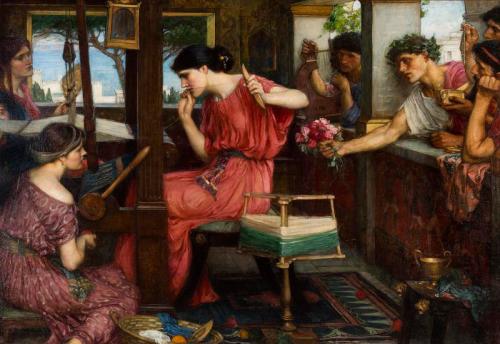
https://commons.wikimedia.org/wiki/File:Penelope_and_the_Suitors_-_John_William_Waterhouse_-_ABDAG003035.jpg
Level 2: Intermediate
Vocabulary
- Running time (noun): How long a film lasts. Runtime is also common.
- Represent (verb): To show or describe something in a particular way, for example in art or film.
- Adapt (verb): To change a story so it works in a different form, such as from a book to a film.
- Atmosphere (noun): The feeling or mood of a place, story or film.
- Unsettling (adjective): Making you feel worried or uncomfortable.
- Dialogue (noun): The words that characters speak in a film, play or book.
- Clumsy (adjective): Awkward and not done with skill. It usually describes movement, but it can also describe speech or writing that does not sound natural.
- Well enough (phrase): In a way that is acceptable, but not excellent.
- Homesickness (noun): A sad feeling of missing your home when you are away from it.
- Tense (adjective): Nervous and unable to relax, often because you are waiting for something to happen.
- Suitor (noun): A man who wants to marry a particular woman. In the story, the suitors are the men who are staying at Odysseus’ home in the hope of marrying Penelope.
- Thought-provoking (adjective): Making you think seriously about something.
Text
The Odyssey, an epic tale of one man’s struggle to get home, of gods and monsters, of a woman under pressure in a world of men, and of a son searching for a father he never knew.
This ancient story has recently been turned into a film by Christopher Nolan. While the film deserves much of its praise, it has left some viewers disappointed.
What I liked
I enjoyed many parts of the film. For example, the filmmakers kept the influence of the gods unclear, adding to their mystery rather than turning them into superhero-like characters. They also adapted the original poem well and kept many important and interesting parts. However, even with a running time of almost three hours, many parts were left out. I wonder whether it would have been better to split the story into two films.
Many people complained about the lack of historical accuracy, but I had no problem with it. The Odyssey was never meant to be a historical document. It is a fantasy story that was told aloud and changed over time before anyone wrote it down. Today’s version is probably quite different from the earliest ones. This means a film does not need to represent one historical time perfectly. For this reason, I thought the costumes and modern fantasy style worked well.
The atmosphere is strange and unsettling and makes us think of a world full of mysteries and danger. In this world you never know if events are natural or caused by some angry god. The film makes us feel that distant lands and peoples are strange and possibly dangerous. Perhaps this is what the ancient Greeks would have felt. This worked far better for me than trying to recreate historically accurate armour or people.
What I didn’t like
However, several parts were disappointing. The dialogue often felt too simple and obvious. Perhaps the film was trying to copy the direct style of the poem, but the characters’ modern language made it feel clumsy. Sometimes it felt as though they were just explaining things to the audience.
In my opinion, Penelope deserved more time in the film. Anne Hathaway showed her sadness and strength well enough, but some important parts were missing. In the poem, I thought of her as Odysseus’ equal in cleverness. The film did not really show this part of her. On the other hand, I thought Tom Holland played the character Telemachus, the son of Odysseus and Penelope, quite well.
Odysseus also felt too simple. Matt Damon played Odysseus in a quiet, serious way, focusing on the bad results of war. But this removed a lot of his personality. In the poem, Odysseus is certainly homesick and maybe tired of war, but he also makes people like him, loves to lie, and uses his intelligence to escape trouble. The film focuses more on his suffering after the war, problems with his crew, and his homesickness. This was a reasonable artistic choice, but it did not work for me.
The film also tried to make Odysseus too much of a simple hero. He regrets what he did at Troy and is shown as a basically good man trying to get home. In the poem, though, he is much harder to like and can be as cruel as any warrior king, which also makes him more interesting.
If you have not seen the film, be warned: the next paragraph contains spoilers (information about what happens in the story).
Odysseus’ return home was good and made me feel tense, but the final fight with the suitors disappointed me. I think the scene tried to mix a semi-realistic fight with an action thriller. For me, it was neither very exciting nor thought-provoking because it never fully chose one or the other.
I think it might have been better if the film had made us enjoy his revenge and then forced us to think about that enjoyment. In the poem, the gods seem to support the killing, and Odysseus even has some of his maids executed for becoming too close to the suitors. If the film had included this or had made some of the suitors easier to feel sorry for, it might have made viewers more thoughtful about the violent revenge. Instead, we get a troubled but good hero defeating completely evil villains.
These are only my personal views, and I hope others will disagree in interesting ways. I think the film is at its best when it leaves things unexplained and at its worst when it makes everything too simple. Overall, it is worth seeing once, but it is probably not a film I will watch again.
Your turn
Here are some questions to increase your understanding and help you remember any new vocabulary. Try answering them with a friend or tutor, or write the answers down. Try to use any new vocabulary in your answers.
- Odysseus loves to lie and trick people to escape trouble. Is it ever okay to lie to get out of a difficult situation?
- Does it matter to you if the costumes and armour in a historical film are accurate? Why or why not?
- In the story, Odysseus comes home after many years away at war. Why might it be difficult for soldiers to return to normal life after a war?
- Odysseus takes violent revenge on the suitors. Is revenge ever the right thing to do?
Did you find this level of English comfortable? Then congratulations! Now you can try the next level of difficulty below.
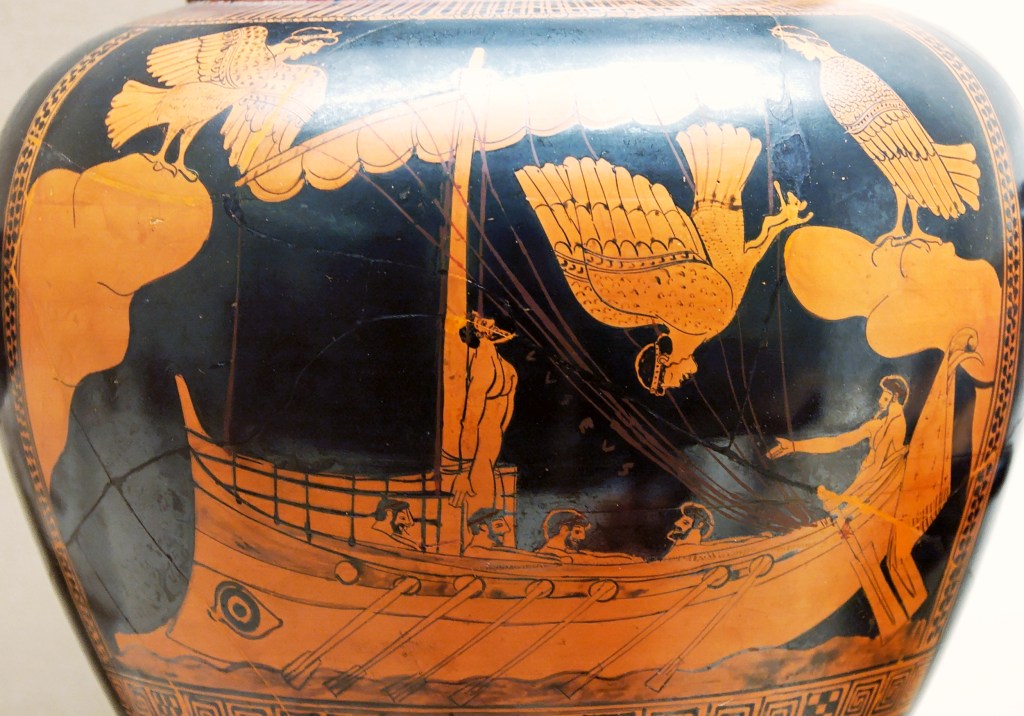
https://commons.wikimedia.org/wiki/File:Odysseus_Sirens_BM_E440_n2.jpg
Level 3: Advanced
Vocabulary
- Besieged (adjective): Surrounded and under constant pressure or attack. It is literally used of a city surrounded by an army, and figuratively of a person who is overwhelmed by unwanted demands.
- Flesh out (phrasal verb): To develop something further by adding more detail or depth.
- On the cutting-room floor (idiom): Removed from a film during editing; more loosely, left out.
- On the nose (idiom): 1. Too obvious or direct, leaving nothing for the audience to work out. 2. Exactly right or accurate.
- Exposition (noun): In a story, information given to the audience to explain background, events or characters, often through dialogue.
- Subdued (adjective): Quiet and restrained, showing little energy or emotion.
- Evoke (verb): To bring a feeling, memory or image to mind.
- Plunder (noun/verb): Goods stolen by force, especially during war; to steal goods in this way.
- Wreak (verb): To cause something harmful, especially in the phrases wreak havoc and wreak vengeance.
- Anticlimactic (adjective): Disappointing because something expected to be exciting or important turns out not to be.
- Cinematography (noun): The art of filming, including how scenes are lit, framed and shot.
- Irredeemable (adjective): So bad that it cannot be saved, improved or forgiven.
- Brutalise (verb): To make someone cruel or violent, especially by exposing them to cruelty or violence.
- Break the mould (idiom): To do something in a new way that is different from what is usual or expected.
Text
The Odyssey, an epic tale of a man’s struggle to get home, of gods and monsters, of a woman besieged in a world of men, of a son looking for a father he never knew.
This ancient tale has once again come to the silver screen in an adaptation by famed director Christopher Nolan. Yet, while the retelling has been a success and certainly deserves a lot of the praise it has received, it has left some with a feeling of dissatisfaction.
What I liked
As for my views on the film, I thoroughly enjoyed numerous aspects. I thought the film did best with what it chose not to show. For example, the filmmakers kept the presence and influence of the gods ambiguous, which added to their mysterious nature and that of the mystical world around them, as opposed to turning them into superhero-type characters. Furthermore, they worked with the source material well, adapting it for the screen while preserving many of the most important and interesting parts. However, even with a runtime of almost three hours, many episodes from the poem were left on the cutting-room floor. A part of me wonders whether it might have been better to split the story into two parts, allowing the film to flesh out the characters, though there are no doubt a myriad of reasons why they chose not to do so.
While many complained about the lack of historical accuracy, I personally had no problem with it. The Odyssey was not meant as a historical document, even if many in the past took it to be one; it is a living, breathing story of fantasy that was passed down orally long before it was ever written – something retold and changed over the ages. The version we have today is almost certainly not the same as the original oral versions, so a retelling has no duty to represent any one specific time period faithfully. For this reason, I think the costume design, as well as the modern fantasy elements and aesthetics that were included, fitted well into a contemporary retelling of such a tale.
The tone is surreal and eerie, aided by excellent cinematography and sound design. It hints at a world where so many unexplained mysteries are just over the horizon, where you are never sure whether the events that occur are merely part of nature or the results of some scorned god or goddess, a world where little is known about distant lands and peoples, with all the fear and anxieties that go along with this uncertainty. In short, I feel the atmosphere created by the visual and audio elements of the film did a great job of evoking the world of the ancient Greeks in a way that makes you feel like one of them, far better than any attempt at recreating ‘historically accurate’ armour or people could ever have done.
What I didn’t like
However, there were many parts that fell flat for me. I often found the dialogue far too simplistic and on the nose. Perhaps the film was trying to mimic the style of the original, which is often quite direct about events, but with the modern tone and register of the characters it felt clumsy and too much like pure exposition; references to the Sea Peoples and the age of bronze collapsing were among the worst offenders.
I also felt that Penelope could have received more screen time. The actress Anne Hathaway conveyed Penelope’s emotional distress and strength of character well enough, but I found vital parts of the character to be underplayed or missing. In the poem, she has always struck me as Odysseus’ equal in cunning and intellect, something that was not shown clearly enough in the film. The aforementioned three-hour runtime is no doubt partly to blame. On the other hand, Telemachus, their son, played by Tom Holland, was given a good amount of screen time, and I found the actor gave a great performance that matched my interpretation of the character very well.
Odysseus also suffers from an oversimplification of sorts. A very subdued Matt Damon played the character, and both the actor and the filmmakers leaned very much into the psychological consequences of war. This, however, had the disadvantage of stripping much of the complexity from his character: his charisma, his deviousness, his ego, and his curiosity. In the poem, Odysseus is homesick and perhaps war-weary, yes, but he is also able to charm people wherever he goes; he loves to lie and deceive; he uses his intelligence as much as his brawn to escape the trouble he gets himself into. In the film there is much more emphasis on a man struggling with the aftermath of war, with the loyalty of his crew, and with his own homesickness. The film made a completely valid artistic choice, but not one that resonated with me for this tale.
Another way I felt the film was trying to smooth out Odysseus’ rough edges was in terms of his morality. In the film he is understandably regretful of his actions in Troy, but is shown most of the time as just doing his best to survive and return home, with the film very much trying to push the idea of a troubled but ultimately good hero that we are used to in today’s cinema. The character in the poem is much less sympathetic in many ways and can be as merciless as any warrior king – he was known as the sacker of cities, after all.
An example of this is when the film showed Odysseus and his men destroying another settlement after starting their journey home. This probably refers to the raid on the Cicones at Ismarus in the poem, which was carried out both for plunder and as a continued act of war after the fall of Troy. In the film, it was framed a little more like an accident of sorts, suggesting the settlement was somehow preventing them from getting home, rather than a brutal raid. It is understandable why they did this; it is hard to support a character who does such things. Yet a story of otherwise good men who had been brutalised by war and so in turn had become more brutal could have made for an interesting contrast and broken the typical Hollywood hero mould. For a film that emphasises the consequences of war so heavily, I would have found this far more compelling.
If you have not seen the film, then be warned: the next paragraph contains spoilers.
Odysseus’ homecoming was not bad and built tension for the final confrontation well enough, but the final battle with the suitors left me dissatisfied. After portraying Odysseus as a man haunted by war for most of the story, the film then had to handle one of literature’s most famous, or infamous, acts of revenge. The film’s version seemed to attempt a mixture of a gritty semi-realistic brawl and a John Wick-style revenge thriller. For me it never fully committed to either, and so provoked neither thoughtfulness nor excitement. I feel there was perhaps room to challenge the audience more, to give them a sense of satisfaction through vengeful violence and then to force them to confront the harsh realities of it. In the poem it is framed as a divinely justified slaughter, and Odysseus even has many of the maids executed – those who had grown too close to the suitors. Including this terrible event, or making some of the suitors more pitiable figures, might have forced the viewer to question their own desire for Odysseus to wreak bloody vengeance on the suitors. Instead, we have a more typically Hollywood framing of a tortured but ultimately good hero defeating the irredeemable villains, which, for me, felt anticlimactic.
These are just my personal views and interpretations, of course, and hopefully many will disagree with me in interesting ways. I think the film is at its best when it leaves things unexplained and at its worst when it does the opposite, simplifying and spelling things out for the viewer. Overall, though, I found it to be certainly worth seeing once, but not a film I am likely to watch a second time.
Your turn
Here are some questions to increase your understanding and help you remember any new vocabulary. You can answer them with a friend or tutor, or write the answers down. Try to use any new vocabulary in your answers.
- Should a film adaptation stay faithful to its source material, or is it more important for it to capture the spirit of the original? Can you think of an adaptation that changed a lot but still worked well?
- Modern films often soften morally complex heroes to make them more likeable. Do you prefer heroes who are clearly good, or characters with darker sides who are harder to sympathise with? Why?
- Can a film both make violence exciting and make the audience question it, or do these two aims always work against each other?
- Do you enjoy films that leave things unexplained and let you decide for yourself, or do you prefer stories that spell everything out? Why?
About the author
Joe Robert Tuckwell is an English tutor and the creator of English with Ideas.
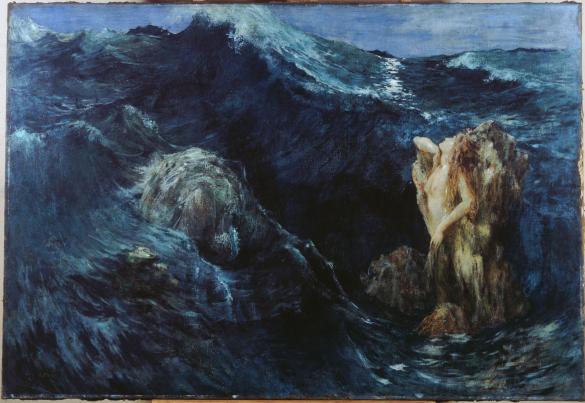
https://commons.wikimedia.org/wiki/File:Charybde_et_Scylla.jpg
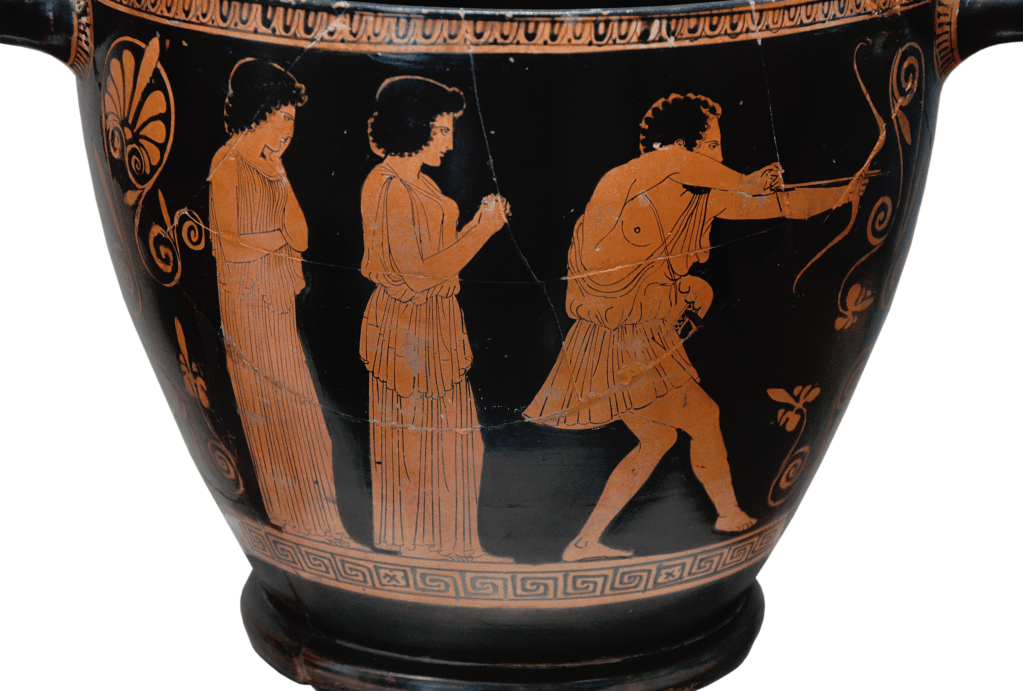
(Below) See page for author, CC BY-SA 2.0 <https://creativecommons.org/licenses/by-sa/2.0>, via Wikimedia Commons


,_around_440_BC,_Altes_Museum_Berlin_(13718420225)_glare-reduced_white-bg.png)
Leave a Reply